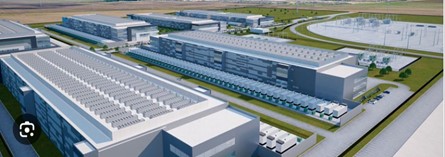
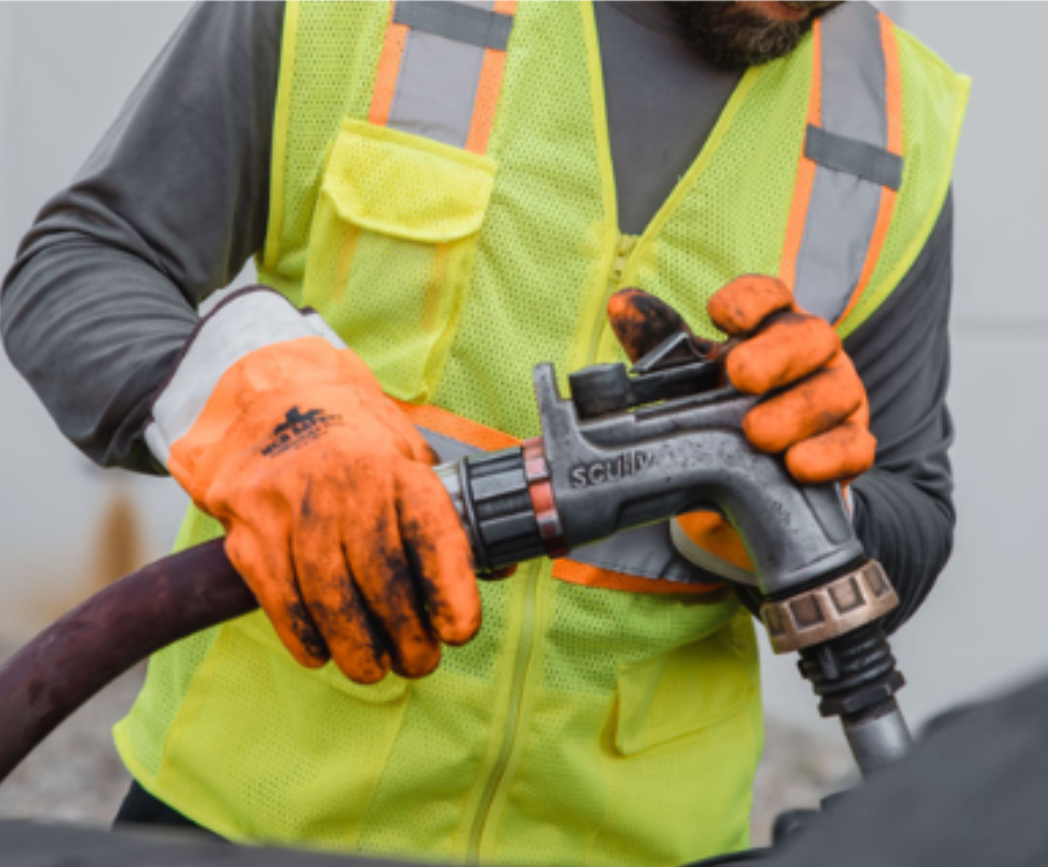
High-flow systems, real-time direction, and infrastructure built for the last 100 feet of fueling.
Most fuel strategies are built around getting fuel to the site—contracts, suppliers, delivery timelines.
But that’s not where the real pressure is.
It’s in the final step. The part where fuel has to move from a tanker into multiple generators, each with its own demand, its own load, and its own timeline.
Modern facilities have made this more complex. Instead of relying on a single bulk tank, they operate with distributed sub-base tanks across dozens of units. That improves redundancy—but it also turns refueling into a coordination problem.
When uptime is on the line, speed alone isn’t enough.
Fuel has to move quickly—but more importantly, it has to move to the right place, at the right time, without hesitation.

When Demand Outpaces Delivery
In a large-scale outage, a site can burn through thousands of gallons per hour, continuously and unevenly across multiple generators. Some units are lightly loaded. Others are carrying critical demand and draining much faster.
Traditional refueling methods weren’t designed for this kind of environment. Transfer rates are limited, unloading takes time, and keeping up requires more trucks, more coordination, and more decisions happening at once.
At a certain point, the math stops working and the gap becomes unavoidable.
If fuel can’t be transferred as fast as it’s consumed, delays compound and risk builds quickly. Once that happens, recovery becomes harder with every passing hour.
You’re no longer operating efficiently—you’re trying to catch up.
Why Traditional Refueling Breaks Down
Limited Equipment Availability
Most fuel tankers on the road are standard gravity-drop trucks without onboard pumps.
Relying on the small percentage that do have pumps creates unnecessary risk—especially during regional emergencies when availability is constrained.
Flow Rate Constraints
Smaller hoses and manual setups limit how quickly fuel can be transferred.
This slows down unloading, increases truck idle time, and creates backups when speed matters most.
The “Human Gap”
In many cases, refueling still depends on manual checks and real-time decisions.
Teams assess tank levels, estimate priorities, and direct trucks based on what they can see in the moment.
It works—until it doesn’t, and under pressure, this becomes a bottleneck.
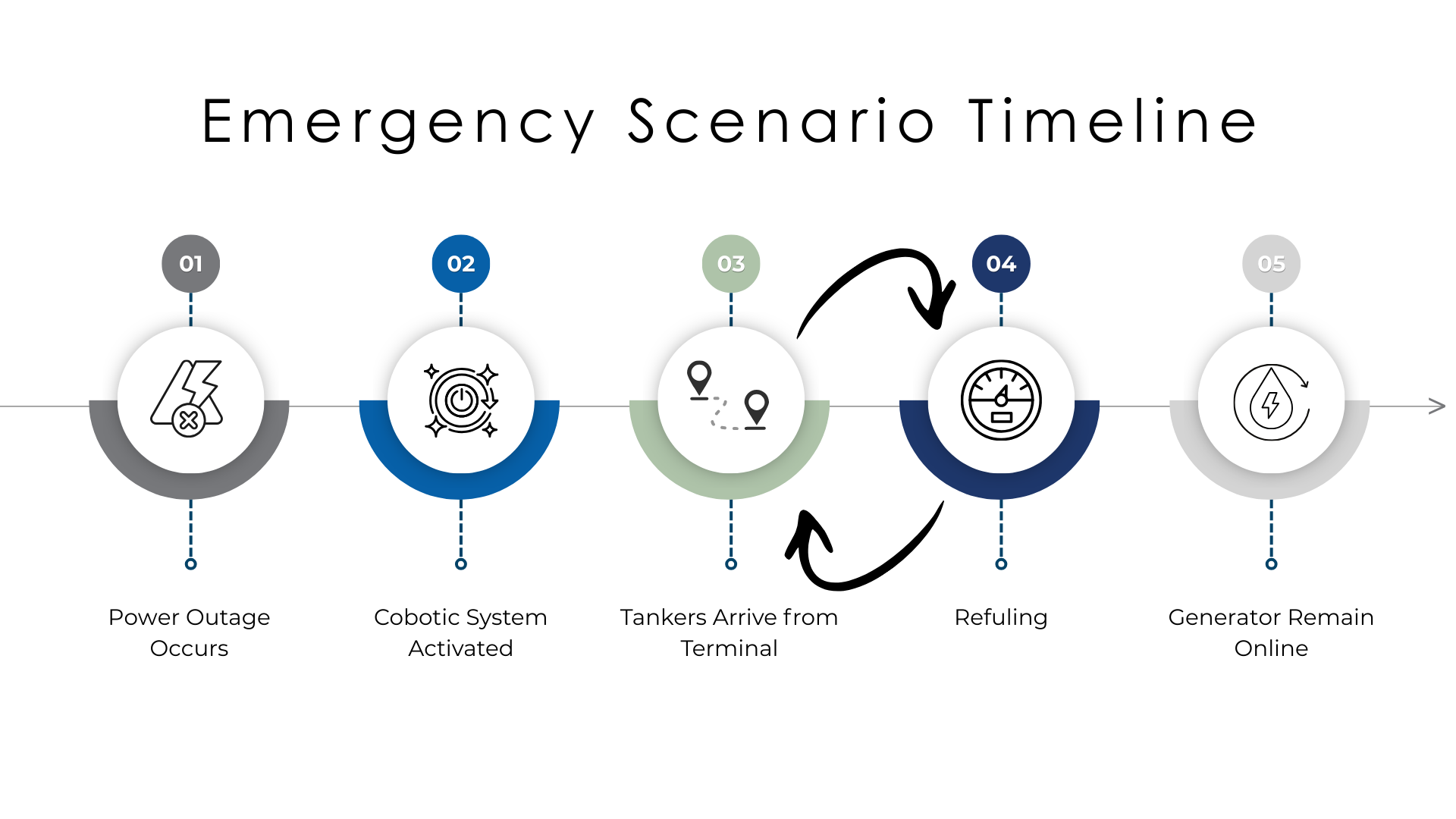
A Different Approach: Fast, Directed Refueling
Speed matters. But without direction, it creates as many problems as it solves.
Earthsafe approaches refueling as a system, not a task. By combining Cobotic Refueling infrastructure with the GenApp intelligence layer, that system is built around two core functions: moving fuel efficiently once it arrives, and determining where it needs to go before it becomes urgent.
The result is a process that moves fuel quickly and deliberately.
What Is Cobotic Refueling?
At the core is the ability to move fuel efficiently once it arrives onsite.
Earthsafe systems are designed to:
- Support high-flow transfer rates (up to ~150 GPM)
- Connect directly to standard gravity-drop tankers
- Eliminate dependency on specialty equipment
This changes how your site operates during an event.
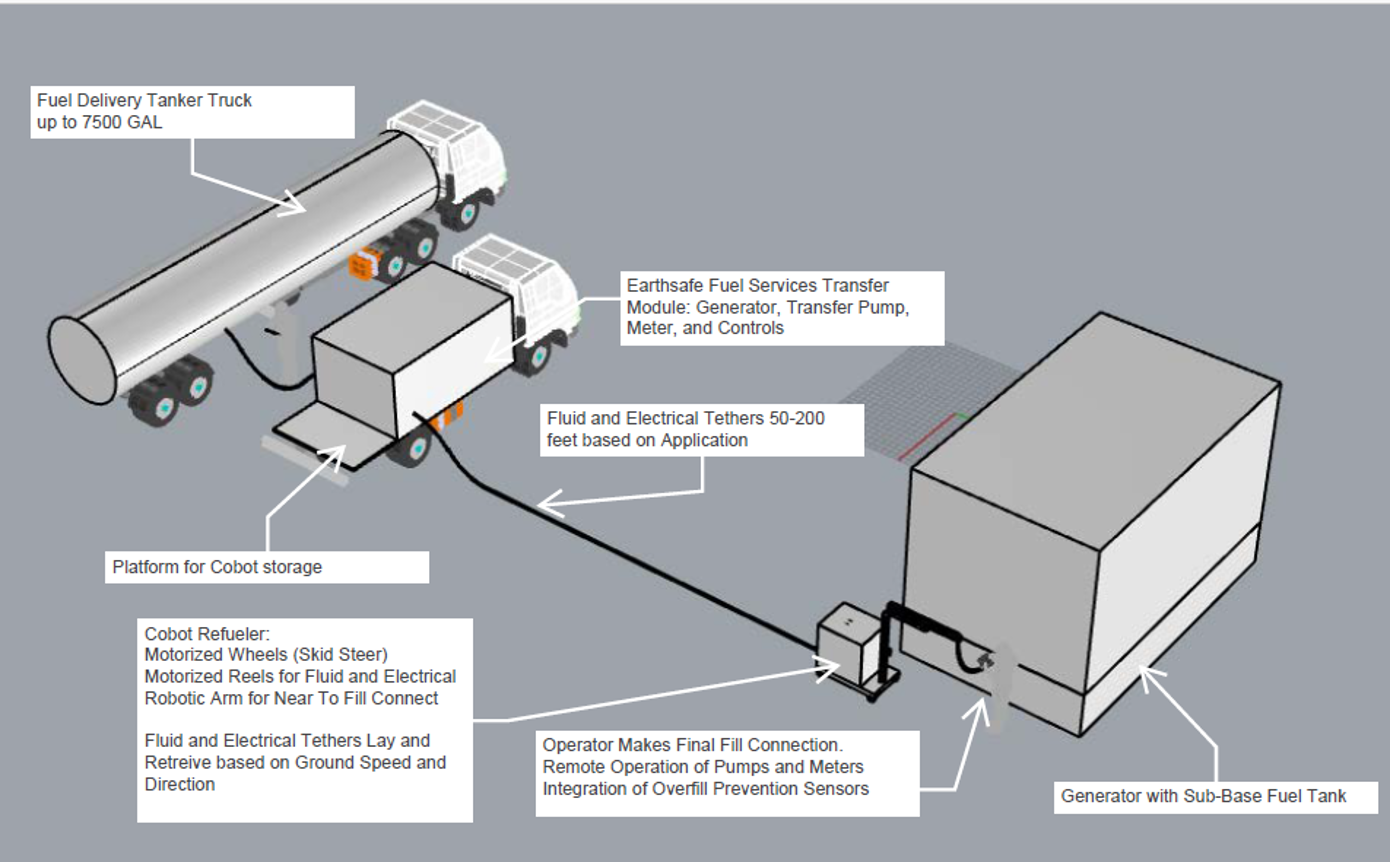
Instead of waiting on specific trucks or working around limitations, you can use what’s available and move faster.
We don’t just increase speed—we remove the constraints that slow everything down.
High-Flow Infrastructure That Removes Bottlenecks
Cobotic refueling is a high-flow, controlled fueling approach that combines mechanical transfer systems with built-in safety and operator guidance. It acts as the interface between the tanker and the generator, allowing fuel to be transferred faster and more consistently while reducing the variability of manual refueling.
On its own, this removes the physical bottleneck. When paired with the GenApp intelligence layer, it becomes part of a coordinated system that not only moves fuel faster, but ensures it’s delivered where it matters most.
Integrating the Intelligence Layer with GenApp
Even with faster transfer, one problem remains: deciding where the fuel should go.
In multi-generator environments, that decision isn’t always obvious. A tank that appears low might not be the most urgent. Another unit, under heavier load, could be much closer to running out.
Without clear visibility, prioritization becomes guesswork.
And in those moments, small misjudgments carry real consequences.
Speed Needs Direction
The GenApp platform adds an intelligence layer to the refueling system by providing continuous visibility into fuel levels, generator load, and consumption rates across the site. Instead of relying on periodic checks or manual estimates, operators have a real-time view of how fuel is being used and how conditions are changing.
Without a high-flow system in place, that level of insight has limited impact. When combined with Cobotic refueling, those decisions can be executed immediately—at the speed the system requires.
From Estimation to Real-Time Awareness
A more controlled approach replaces estimation with awareness.
By continuously monitoring fuel levels and tracking how quickly each generator is consuming fuel, it becomes possible to understand not just where things stand—but where they’re headed.
That shift changes how decisions are made.
Targeted Refueling Instead of Reactive Refueling
Instead of asking:
“Which tank looks lowest?”
You’re answering:
“Which unit runs out first?”
Fuel is no longer just being delivered.
It’s being allocated.
The result is a process that’s not only faster, but more predictable—where each movement is informed by real conditions across the entire system.
High-flow transfer moves fuel faster.
The intelligence layer ensures it gets to the right place.
Unlocking Your Fuel Supply
Refueling infrastructure doesn’t just impact how fast fuel moves—it determines what fuel you can access in the first place.
When a site can’t efficiently unload standard tankers, it’s forced into smaller, less efficient deliveries. That often means higher costs, longer wait times, and fewer options during critical moments.
With the right infrastructure in place, those limitations fall away. Standard full truckload deliveries become viable, giving you access to a much broader portion of the fuel network. More suppliers can serve your site, and fuel can be delivered and transferred without unnecessary delays.
Instead of working around constraints, your operation becomes aligned with how fuel is actually distributed at scale.
Your infrastructure shouldn’t limit your supply chain.
Built for Safer, More Controlled Operations
Speed without control introduces risk. The goal isn’t just to move fuel quickly—it’s to move it in a way that’s predictable and manageable under pressure.
Earthsafe systems are designed to support compliance with key industry frameworks, including NFPA 110 (Emergency and Standby Power Systems) and NFPA 30 (Flammable and Combustible Liquids Code). These standards define how fuel systems should perform in terms of safety, reliability, and spill prevention—especially during high-risk scenarios like extended outages.
Controlled transfer rates, integrated shut-off mechanisms, and predictable connection points all contribute to safer operation. Instead of relying on manual intervention to prevent overfills or spills, safeguards are built directly into the process. This creates a more consistent and auditable approach to fuel handling—one that aligns more closely with the intent of these standards.
Just as importantly, reducing the need for manual oversight in active fueling zones helps limit personnel exposure, which is a key consideration in both safety planning and compliance.
The result is a process that’s easier to manage, easier to repeat, and far less dependent on individual judgment during critical situations.
From Manual Coordination to Controlled Execution
In many environments, refueling still relies on a reactive process. Teams check tank levels manually, trucks wait for direction, and decisions are made on the fly using incomplete information.
It works, but it creates friction at every step.
When the process is structured, that friction disappears. Fuel levels are visible, priorities are clear, and movement becomes deliberate instead of reactive. Trucks arrive with purpose, transfers happen without hesitation, and the entire operation runs with a level of consistency that manual coordination can’t match.
Same fuel. Same trucks.
A completely different level of control.
The Bottom Line
Fast refueling isn’t just about speed—it’s about coordinating movement and decision-making at the same time.
It’s about having the infrastructure to support it, the visibility to prioritize it, and the control to execute it when it matters most.
Cobotic refueling provides the ability to move fuel at scale. The GenApp intelligence layer ensures it’s directed where it’s needed most.
Together, they create a system that performs reliably under real conditions.
Because in the end, reliability isn’t decided when fuel is ordered.
It’s decided in the moment it has to move.
Let’s Look at Your Current Approach
Every site is different, but the challenges tend to follow the same pattern.
If you’re evaluating your current process, the most useful place to start is identifying where delays, uncertainty, or constraints are introduced.
That’s where the biggest improvements usually come from.
Common Questions About Fast Refueling
A: We use predictive "Time to Empty" (TTE) analytics. By combining real-time fuel level data with the generator's current load/burn rate, we prioritize units with the shortest remaining run-time, rather than just the lowest fuel percentage.
A: Yes. Our GenApp system uses a Cellular LTE-M / NB-IoT connection that does not touch the facility's Ethernet or Wi-Fi networks, eliminating it as a potential cyber-attack vector.
A: No. Systems are designed to work with standard tankers, improving flexibility and availability.
A: Absolutely. Automated logs replace manual paper logs, providing an auditable trail of fuel levels, consumption rates, and refill volumes required for regulatory compliance.
A: Yes. Faster transfer rates and better prioritization reduce delays and improve overall coordination.